Artificial Intelligence is no longer simply about generating content, answering questions, or improving productivity.
In 2026, the biggest shift in the AI landscape is the transition from AI as an assistant to AI as an active participant in business operations. Organisations are moving beyond experimentation and beginning to integrate AI directly into workflows, decision-making processes, and enterprise systems.
The result is a new era of intelligent operations where AI doesn't just provide recommendations. It helps execute work.
1. Agentic AI Is Becoming the New Standard
The most significant trend in AI today is the rise of Agentic AI. Unlike traditional chatbots that respond to prompts, AI agents can plan tasks, access tools, retrieve information, make decisions within defined boundaries, and complete multi-step workflows.
Organisations are increasingly exploring AI agents for:
- Customer support automation
- Data analysis and reporting
- Compliance monitoring
- Workflow orchestration
- Internal knowledge management
The focus has shifted from asking AI questions to assigning AI responsibilities. For business leaders, the key question is no longer "How can AI help my team?" It's becoming "Which processes can AI own?"
2. AI Is Moving From Pilots to Production
For the past two years, many organisations have been experimenting with AI through isolated proof-of-concept projects. Now the focus is on operational deployment.
Leading organisations are embedding AI directly into business workflows rather than treating it as a standalone tool. AI is increasingly becoming part of the enterprise operating model itself.
However, scaling AI remains challenging. Many organisations struggle with governance, data quality, integration complexity, and security requirements. Success is increasingly determined by operational readiness rather than model performance alone.
3. Multi-Agent Systems Are Emerging
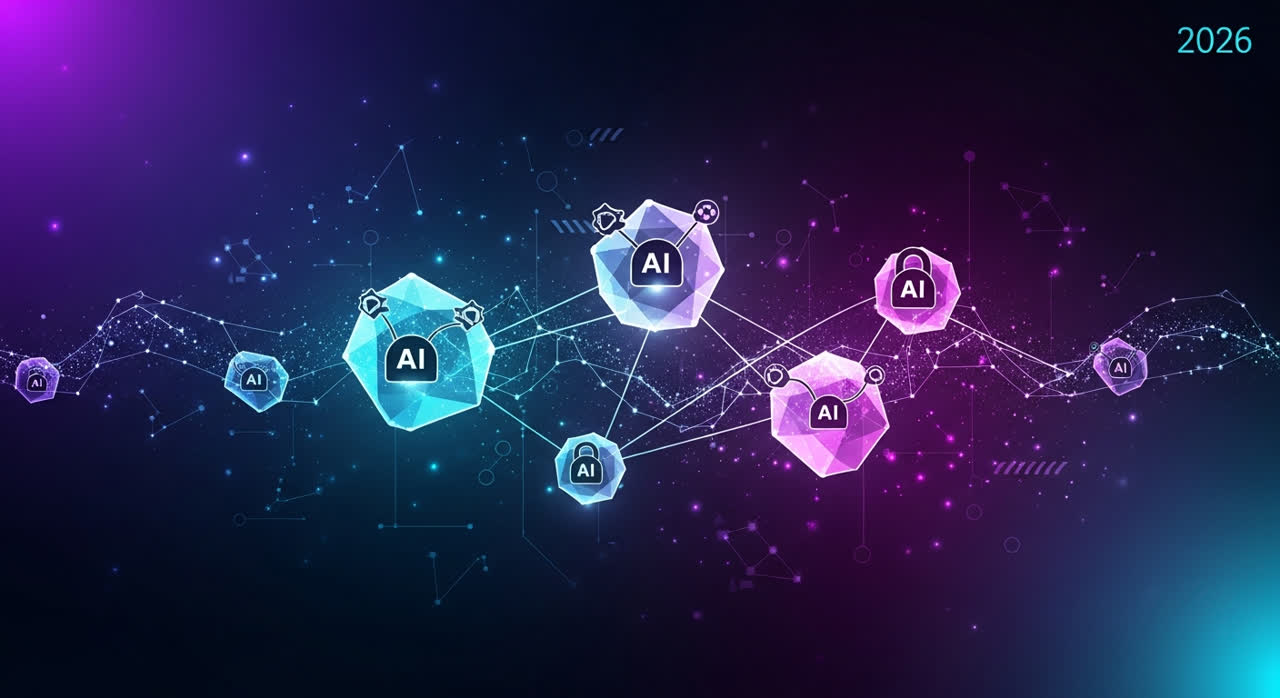
One AI agent can complete a task. Multiple specialised agents can run an entire process.
Multi-agent systems are becoming a major focus across enterprise AI initiatives. These systems allow multiple AI agents to collaborate, each handling specific responsibilities within a larger workflow. For example:
- One agent gathering data
- Another validating compliance requirements
- A third generating recommendations
- A fourth executing approved actions
This creates more scalable and flexible automation than traditional rule-based systems. Organisations are increasingly viewing AI architecture similarly to how software evolved into microservices: modular, specialised, and orchestrated.
4. Multimodal AI Is Expanding Beyond Text
AI is becoming capable of understanding and reasoning across multiple forms of information simultaneously. Modern systems can increasingly process text, images, audio, video, documents, and structured business data.
This multimodal capability allows AI to interact with information much closer to how humans work. For organisations, this opens opportunities in areas such as document intelligence, visual inspections, ESG evidence collection, operational reporting, and risk monitoring. The ability to combine diverse data sources is becoming a competitive advantage.
5. Smaller Models Are Delivering Bigger Value
Bigger is no longer always better. A growing trend in enterprise AI is the adoption of Small Language Models (SLMs) that are optimised for specific business tasks.
Benefits include lower operating costs, faster response times, improved data privacy, easier deployment, and reduced infrastructure requirements. Rather than using a single large model for everything, organisations are increasingly deploying specialised models for focused use cases — often delivering better business outcomes at a fraction of the cost.
6. AI Governance Is Becoming a Business Priority
As AI becomes embedded in core operations, governance has become one of the most important strategic considerations. Organisations are increasingly focused on transparency, accountability, data security, compliance, auditability, and human oversight.
The challenge is not simply deploying AI. The challenge is deploying AI responsibly. Companies that establish strong governance frameworks today will be better positioned to scale AI confidently tomorrow.
7. The Competitive Advantage Is Shifting
The early AI race was about access to models. Today's AI race is about integration.
Most organisations can access similar AI capabilities. What differentiates leaders is how effectively they connect AI to their people, processes, and data. Organisations that successfully integrate AI into everyday operations are beginning to unlock faster decision-making, increased productivity, lower operational costs, improved customer experiences, and greater organisational agility.
The advantage increasingly belongs to those who operationalise AI, not simply adopt it.
Looking Ahead
The AI landscape is evolving at an unprecedented pace. While new models continue to capture headlines, the most important developments are happening inside organisations where AI is becoming part of how work gets done.
The future of AI is not just smarter technology. It is intelligent systems working alongside people to drive measurable business outcomes. For organisations preparing for the next phase of digital transformation, the question is no longer whether AI will change the way work happens — it's how quickly they can adapt.
How Okiru Helps Organisations Navigate the AI Era
As AI becomes increasingly integrated into business operations, organisations need trusted data, governance, and visibility to ensure successful adoption. Okiru enables businesses to centralise operational, ESG, risk, and performance data, creating a reliable foundation for AI-driven insights and decision-making.
By providing structured, high-quality information and enterprise-wide visibility, organisations can implement AI initiatives with greater confidence, transparency, and measurable impact. In the age of intelligent operations, success depends not only on AI capabilities but on the quality of the data and governance supporting them. Okiru helps organisations build that foundation.